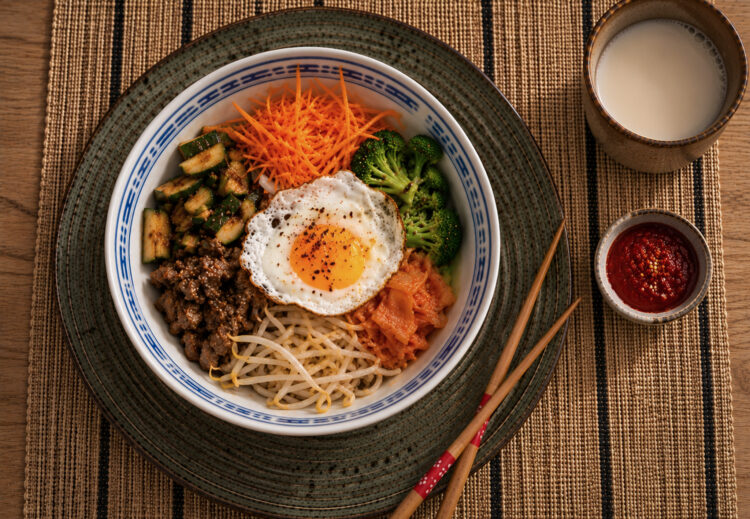
And then there’s this easy bibimbap, one of my favorite Korean recipes. I discovered Korean food relatively late in life, but once I did, it stuck. I’ve never actually been to Korea (yet!), but who knows, maybe one day.
I love those intense flavors, the Korean BBQ, all that delicious grilled meat wrapped in lettuce leaves. If that’s your thing too, check out my Korito.
Bibimbap, I like to think of it as the Korean poke bowl, although bibimbap was around long before poke bowls became a thing. So you could better say, poke bowl is the Japanese bibimbap.
Bibimbap literally means mixed rice, which pretty much sums it up. What I love about this easy bibimbap is that you can pretty much throw in whatever vegetables you have in the fridge. Broccoli? Sure. Zucchini? Why not. Make it vegetarian with shiitake mushrooms, or add beef or fish. I use brown rice because I like it, and I don’t spend hours marinating everything separately.
For me, it’s the gochujang (Korean chili paste) and gochugaru (Korean chili flakes) that really bring those Korean flavors to the table. Whether you put them on zucchini, beef or salmon, they just make everything taste better.
So here’s my take on bibimbap. Not exactly traditional, but really, really good.
BLF balance ⓘ How balanced the recipe is across protein, plants, fibre, quality fats and variety.
9 / 10
BLF Flavor
9 / 10
BLF Easy
7.5 / 10
MAKE IT MORE BALANCED
Use the sauce on the dish, it does do that extra something. (Flavor boost)
Sprinkle some crushed roasted cashews as an extra crunchy topping. (+0.5)
Finish with toasted sesame seeds (Flavor boost)
Nourishment, this easy bibimbap
Fiber: high (~11–13 g per serving)
Healthy fats: moderate (sesame oil, sesame seeds & egg)
Veggie level: high
Keeps you full: very well
Mood: spicy, colorful & comforting
2 servings
20 minutes
12 minutes
~42 g beef / ~29 g shiitake & edamame per serving
 Print
Ingredients
150 gr brown rice
2 eggs
250 gr beef strips or 200 gr shiitake mushrooms + 150 gr edamame
150 gr broccoli
1 medium carrot
100 gr bean sprouts
½ zucchini
100 gr kimchi
1 spring onion
1 tsp gochugaru (Korean chili flakes), or to taste
1 tsp sesame seeds
Neutral oil for frying
- Marinade (beef or shiitake)
2 tbsp soy sauce
1 tbsp sesame oil
1 big garlic clove
1 thumb ginger, finely grated (optional)
1 tbsp gochujang (optional)
½ tsp honey (optional)
- Sauce (optional)
1 tbsp gochujang
1 tsp sesame oil
1 tsp rice vinegar
½ tsp honey
2 tsp water
Directions
- Marinate the beef or shiitake. Mix the soy sauce, sesame oil, grated ginger, garlic, gochujang and honey in a bowl. Add the beef strips or sliced shiitake and toss until everything is nicely coated.
- Cook the brown rice according to the package instructions.
- Cut the broccoli into small florets, julienne the carrot and slice the zucchini into thin strips or half-moons. Slice the spring onions, keeping some of the green parts for topping.
- Want to try sauce? Mix the gochujang, sesame oil, rice vinegar, honey and a splash of water until smooth. Add a little more water if you prefer a thinner sauce. Set aside.
- Heat a little neutral oil in a large frying pan or wok. Start with the broccoli and a splash of water, cooking until just tender. Put aside. Add the zucchini and some of the marinade or just some soy and stir-fry until cooked but still with a little bite. Put aside and top with some sesame seeds and gochugaru (Korean chilli flakes)
- Use the same frying pan and heat again a little bit of neutral oil. Cook the marinated beef strips over medium-high heat until nicely browned and cooked through. If using shiitake, fry until golden and slightly caramelized.
- Fry two eggs sunny-side up. You want the whites completely set, with a soft, runny yolk. Sprinkle with a little gochugaru.
- Divide the brown rice between two bowls. Arrange the vegetables, beef or shiitake, carrot, bean sprouts and kimchi on top. Add a fried egg to each bowl.
- Scatter over the green spring onion, sesame seeds and a little extra gochugaru if you like things spicy. Serve with the bibimbap sauce on the side.